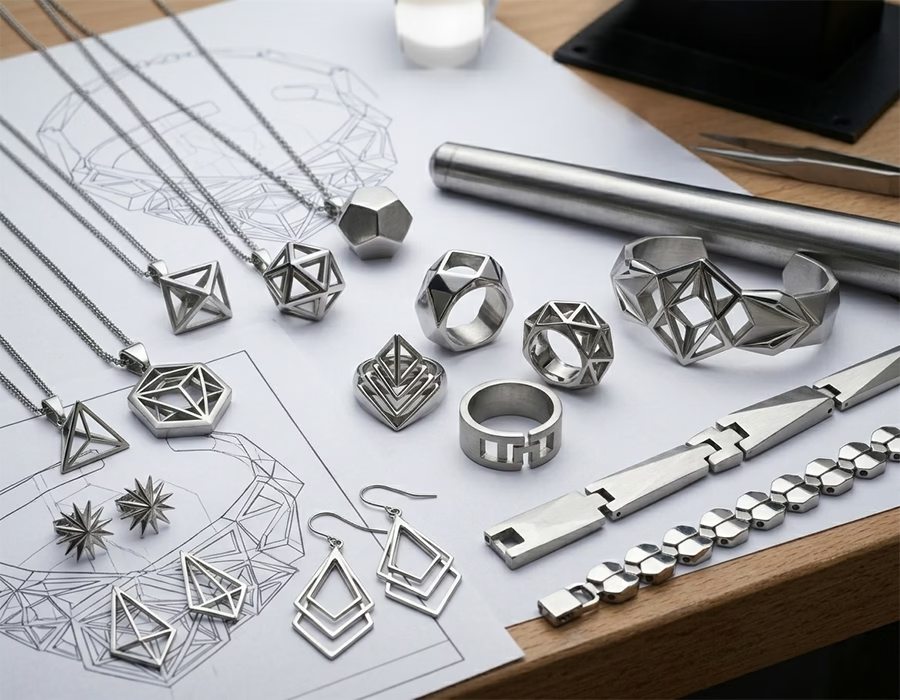
Current trends in modern jewelry design lean toward geometric shapes, sharp lines, and architectural influences. With designs incorporating interlocking hexagons, layered polygons, openwork lattices, and custom logos, geometric jewelry offers bold, contemporary looks for fashion-focused brands, designers, and corporate clients worldwide.
Creating geometric jewelry from stainless steel presents challenges far greater than those of traditional organic forms or softer precious metals. The primary reason is that the superior hardness and structural stability of stainless steel require innovative digital engineering, great precision in industrial manufacturing processes, and the highest level of artisan craftsmanship.
At Jinyuan Jewelry, we have the experience and expertise required to manufacture high-quality stainless steel jewelry using both OEM and ODM services. Our team has developed advanced metallurgical techniques over many years with the specific intent of producing highly detailed geometric rings, pendants, earrings, and bracelets that deliver precise visual detail and exceptional stability for everyday use.
In this article, we will provide you with insight into how our engineering team designs and engineers custom geometric jewelry that can be manufactured into aesthetically pleasing, market-ready pieces.
Why Geometric Steel Jewelry Is Capturing the Global Market
Geometric jewelry captures consumer attention by merging structural complexity with minimalist sophistication.
Core Product Trends in Geometric Lineages:
- Architectural Rings and Polygon Bracelets: Hard-edged structures like hexagonal rings or multi-faceted cuffs that catch light from varying angles.
- Intricate Cutouts and Openwork Geometry: Delicate openwork necklaces featuring precise mandalas, matrix patterns, or hollowed-out frames.
- Custom Logo Geometry: Premium corporate gifts, brand merchandise, and promotional jewelry crafted accurately from vector brand assets.
- Forged Damascus Steel Strata: Utilizing the natural, high-contrast layered patterns inherent to forged steel for rugged, premium aesthetics.
Key Strategic Benefits for Jewelry Brands
| Benefit | Technical and Market Advantage |
| Architectural Aesthetic | Delivers a luxury, avant-garde appearance that stands out in saturated retail markets. |
| Instant Recognition | Sharp, precise geometric shapes firmly reinforce a brand’s unique design identity. |
| Flawless Customization | Seamlessly integrates geometric vector logos without blurring original silhouettes. |
| Universal Unisex Appeal | Clean line structures appeal strongly to both men’s and women’s fashion demographics. |
| High Perceived Value | Sharp facets and microscopic symmetry elevate the product’s premium retail price point. |
The Core Manufacturing Challenges of Steel Geometry
Geometric-style steel jewelry is rapidly gaining popularity worldwide. Many consumers are drawn to their unique, attractive designs that blend complex shapes with minimalist elements.
Trends in Different Product Categories Within Geometric Jewelry Would Include:
- Architectural Rings & Polygon Bracelets: Sharp-edged structures such as hexagonal rings and multi-faceted cuff bracelets have been designed to highlight how these implements reflect the changing angle of light during everyday use.
- Intricate Cutouts & Openwork Geometry: Beautiful yet delicate examples of openwork necklaces, featuring intricate mandalas, matrix design patterns, and hollow designs within them.
- Custom Logo Geometry: High-quality promotional items and branded merchandise from companies have been designed with exacting specifications and manufactured from the geometric vector brand assets provided by those companies.
- Damascus Steel with Forge Lines: The use of the high contrast patterned look created by the forging process to create one of the finest lines of rugged products available today, and represents an even higher-end look compared to the forged steel product.
Our Technical Workflow: From Concept to Perfect Form
To execute these complex designs flawlessly, our factory adheres to a rigorous engineering framework that transforms a design from an abstract idea into a structural masterpiece.
- Attention (Conceptualization/Schematic): To capture the innate creativity of the designer and the designer’s intention.
- Explanation (3D Computer-Aided Design Modeling): To convert the sketch into computer-generated blueprints.
- Commitment (Precision Fab): To use large heavy machines to fabricate the metal.
- Concluding (Artisan Finish): To polish and plate the product to a point of retail readiness.
Digital Prototyping and Stress Simulation (CAD Stage)
In our 3D CAD modeling software, we build our geometry. For each client file, we will optimize the original sketch to ensure the design is appropriate for stainless steel’s properties.
- Stress Analysis: We simulate everyday wear and tear to identify stress concentration points at sharp internal corners. Our engineers then subtly adjust wall thicknesses or add microscopic radii to ensure the piece will not crack or bend, without compromising its sharp exterior lines.
- Finishing Pre-Calculation: We calculate the accessibility of the geometry’s deep recesses to verify that automated tumbling pins and manual polishing wheels can clean every crevice.
Advanced Manufacturing Technologies We Deploy
Depending on the dimensions, depth, and texture of the geometric pattern, we utilize a combination of cutting-edge machinery and advanced metallurgy.
CNC Machining (Milling) for Three-Dimensional Precision
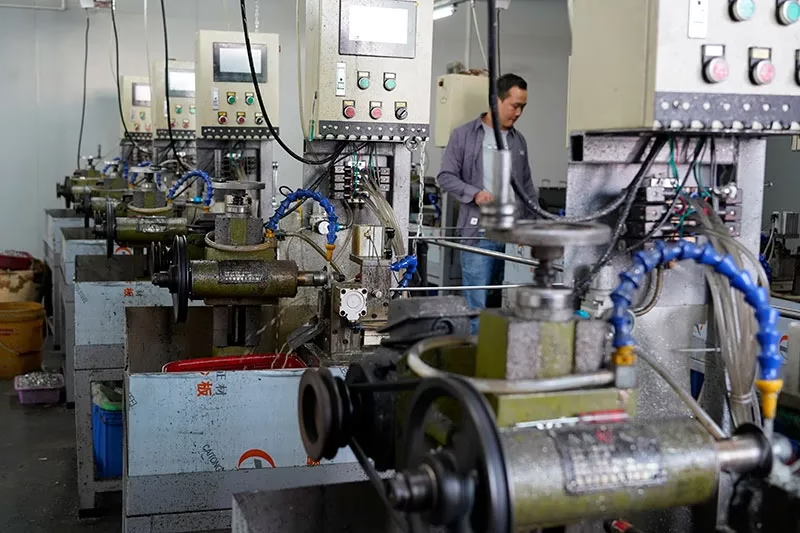
We use CNC (Computer Numerical Control) machining to make architectural rings, mechanical-style components, and thick signet pendants. Instead of casting them, we can create jewelry by carving them from solid blocks of 316L medical-grade stainless steel with our multi-axis CNC machines. This allows for micro-metric tolerances, perfectly sharp multi-faceted edges, and tight tolerances for assembling the parts.
Fiber Laser Cutting for Intricate Openwork Cutouts
To produce delicate lattice structures, layered nameplates, and openwork geometric-style earrings, we use high-powered Fiber CNC Laser Cutting (Fiber CNC). A Fiber CNC machine uses an ultra-fine laser beam to melt the steel sheet along precise vector paths, creating the desired shape. Since the laser’s heat is concentrated only at the cut surface, there is very little heat-affected area, which prevents warping or discoloration of the metal and produces razor-sharp internal angles.
Chemical and Acid Etching for Fine Textured Patterns
When it comes to creating complex surfaces on flat sheets of metal (like floral lines or repeating tiny geometric patterns), where the desired effect is to etch only partially (not cut) through the metal, precision chemical etching will be used.
- We begin by applying a light-sensitive protective coating to the steel that needs to be etched.
- Once the protective coating is applied, the exact geometric linework will be exposed using a CO2 laser.
- The piece will then be placed in an acid bath under precise control; the acid will eat away at the areas of the steel where no protective coating was applied, resulting in a uniform, high-contrast texture and visual depth.
Precision Die Casting and Metal Injection Molding (MIM)
For mass production of high-volume, deeply dimensional 3D geometric shapes that are not physically reachable with milling tools, molten stainless steel is injected into custom-tooled steel molds at an approximate temperature of 2000 degrees Celsius. This enables very high repeatability and density across thousands of production cycles.
Artisan Finishing, Polishing, and Wearability Engineering
Steel that has been machined or cast will be quite rough and sharp-edged. The true skill of creating a geometric piece of jewelry is to create an edge profile that looks like a razor (to the naked eye) but feels incredibly soft, smooth, with zero sharp edges, and comfortable when worn against the skin.
Our Multi-Step Polishing Regime:
- Magnetic Pin Tumbling and Machine Grinding: The raw pieces are automatically polished with eco-friendly polishing compounds and specialty stainless steel pins in a Vibratory Wet Tumbler. The process helps remove micro burrs from hard-to-access areas of the finished pieces.
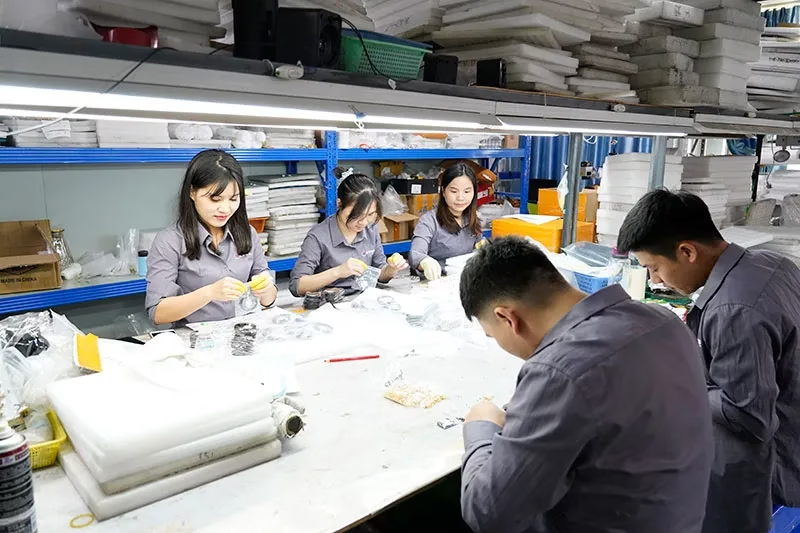
- Master Hand-Polishing: The skilled artisans who finish the pieces under our trained artisans’ custom buffing wheels understand how to properly apply pressure to the flat geometric facets to produce a highly polished, mirror-like brilliance (without rounding or smudging the intentional crisp edges).
- Contrast Texturing: We commonly use a two-step finishing process to create dramatic visual depth by finishing one geometric plane with highly polished brilliance and the adjoining facet with a precision sandblasted, industrial brushed, or satin hammered finish.
Popular Surface Finishes and Effects
| Finish Type | Visual and Tactile Effect |
| Mirror Polish | Ultra-reflective, high-end luxury sheen |
| Brushed / Satin | Linear texture, contemporary industrial feel |
| Sandblasted | Soft, diffused matte contrast |
| Hammered | Multi-faceted, organic architectural glow |
Premium Vacuum PVD Plating and Post-Production Customization
We use a process called Physical Vapor Deposition (PVD) Vacuum Plating to enhance the aesthetic quality of our geometric products with high-quality color. This is the highest quality/style of use in the industry for fashion jewelry.
Unlike cheap, low-quality plating systems that typically use chemicals to create an electroplate that wears off quickly and, in many cases, have a nickel underlayer (which can cause allergic reactions), our PVD plating system vaporizes titanium and genuine gold in a high-vacuum chamber. It is a very uniform, hypoallergenic coating that is deposited directly onto the steel surface.
- Available Premium Tones: 14K/18K Yellow Gold, Rose Gold, Platinum, Deep Black, Gunmetal, and Dual-Tone.
- Flawless Adhesion: Ultrasonic cleaning removes all residual polishing compounds before plating, ensuring the gold coating adheres perfectly to the tightest internal geometric corners without pooling.
Specialized Stone Setting and Accents:
Traditional wax settings are not suitable for solid stainless steel because it’s far tougher than silver or copper. We use innovative post-production stone setting methods instead:
- CNC and Prong Settings: Micro-drilled by a CNC machine, with prongs hand-pressed under magnification to snugly secure high-quality cubic zirconia (3A to 5A) or moissanite stones into geometric matrix arrays with precision.
- Bezel and Sandwich Welds: Securely hold the stones between 2 interlocking metal pieces that have been laser-welded together, allowing the gemstones to be visible from both sides.
- Enameling and Antique Blackening: An infusion of colored liquid enamel creates beautiful blocks of color in the geometric recesses of your jewelry; alternatively, a controlled oxidation process can be used to create an aged appearance while enhancing the fittings in high-contrast colors.
Our Quality Control: Maintaining Absolute Symmetry
Symmetry is the basis of all beauty in geometry. To ensure that every batch produced using mass production has the same level of quality without distortion, we have a multi-checkpoint quality control (QC) matrix that uses highly sophisticated measurement metrology to enforce consistency:
- 3D Coordinate Measuring Microscopes and Optical Comparators: Our team confirms angles to within a micron by digitally cross-referencing physical manufacturing samples with the original, authenticated digital CAD blueprints.
- Multi-Angle Lighting Inspection: Each piece is then inspected from multiple angles using varying light intensities. This helps us confirm the levelness and uniformity of each facet and eliminate any waves or density variations that may have occurred during plating.
Turn Your Complex Geometric Vision into Reality
Jewelry with complex geometry represents the intersection of creativity and engineering. Although the designs may appear simple or clean, producing them accurately requires a dedicated manufacturer who can skilfully work with some of the toughest commercial metals, such as stainless steel.
At Jinyuan Jewelry, we use CAD optimization, CNC milling, laser cutting, and quality craftsmanship to help you achieve your vision with precision.
If you would like to create or expand your unique geometric line, create a geometric collection, or create a logo-based collection, please email our engineers at sales@jinyuanjewelrycn.com, so we can assist you in meeting your production goals.

With over 10 years of experience in the stainless steel jewelry industry, Lydia Ling brings deep industry knowledge and hands-on market expertise to her role. As an accomplished Sales Manager, she has a strong understanding of product development, manufacturing processes, and global customer needs. Through the company blog, Lydia shares practical insights and industry know-how to help readers better understand stainless steel jewelry and make informed business decisions.