For jewellery brand owners, sourcing managers, and product designers, a necklace clasp is a fundamental structural component that dictates the durability, weight distribution, daily ergonomics, and overall market value of a finished piece.
Selecting an incorrect clasp can cause immediate product issues—such as chain twisting, metal fatigue, or the loss of high-value pendants. Conversely, engineering the correct clasp-to-chain combination preserves the design’s structural safety, balances wearability, and strengthens consumer trust.
Whether your company focuses on premium 316L stainless steel OEM/ODM manufacturing, fine sterling silver, or high-end bead and pearl stringing, this guide covers the mechanical and stylistic principles required to make informed manufacturing decisions.
1. The Functional Mechanics of Clasp Selection
In professional jewellery development, every component must be evaluated for its structural performance and material compatibility. Our engineering teams evaluate closure findings based on four main technical benchmarks:
- Tensile Security and Load Capacity: The fastening mechanism must support the specific weight of the chain links, stone settings, or heavy custom pendants without opening under sudden physical tension.
- Weight Distribution (Counter-Balancing): A clasp assembly that is too light will cause a necklace to spin forward, pulling the front upward. A clasp that is too heavy will pull the design backwards, causing discomfort around the neck.
- Mechanical Integrity: Internal spring coils or interlocking metal tabs must withstand thousands of friction cycles without experiencing tension loss or structural warping.
- Material Compatibility: The base alloy of the clasp must complement the chain body to ensure uniform wear and prevent premature tarnishing, especially when applying high-grade surface finishes like PVD vacuum plating.
2. Technical Analysis of Industry-Standard Clasps
Different necklace styles, target weights, and consumer demographics demand specific closing mechanisms. Below is a breakdown of the leading industry findings used in commercial jewellery production.
① Lobster Clasp (Trigger Clasp)
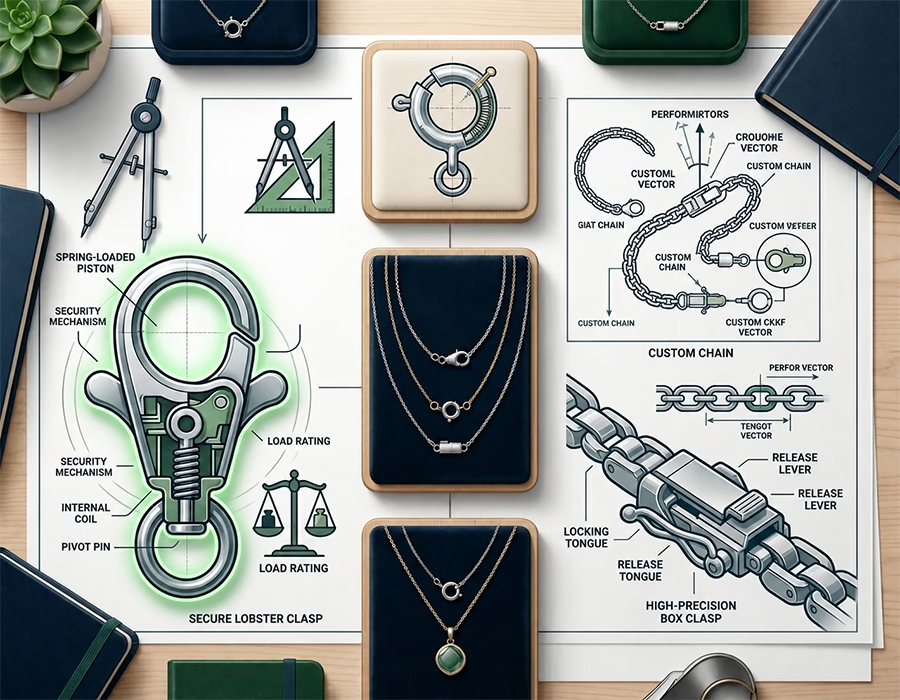
The commercial standard for modern jewellery production. It utilizes an internal spring-loaded lever that securely holds a pivoting arm against a solid ring loop.
- Best For: Everyday-wear chains, heavy custom pendants, industrial stainless-steel lines, and high-volume wholesale orders.
- Technical Advantage: Offers excellent compatibility with precision PVD vacuum coating. Upgraded swivel variants feature a 360-degree rotating base to prevent fine chains from twisting. Due to its high tensile strength and resistance to daily wear and tear, this closure is the industry standard for industrial lines—a topic analysed in depth in our manufacturing overview, “Customising Heavy-Duty Men’s Chains”.
- Limitations: Requires a certain level of finger dexterity and can be difficult to open for users with long fingernails.
② Spring Ring Clasp
A lightweight, classic, and economical circular closure. It features a hollow circular tube enclosing an internal steel wire spring activated by a tiny slide trigger.
- Best For: Delicate minimalist chokers, fine cable chains, and entry-level fashion lines.
- Technical Advantage: Highly discreet, low physical footprint, and minimal production cost for bulk volume runs.
- Limitations: Lower tensile capacity. The thin internal wire spring can experience tension fatigue under heavy loads or when improperly pickled during plating.
③ Box Clasp
A premium engineered solution where a faceted metal tab (or tongue) slides directly into a hollow box frame until it engages with a mechanical click. High-end variations include external figure-eight safety wire latches for secondary security.
- Best For: Tennis necklaces, high-value diamond or gemstone collars, premium bridal jewellery, and structured luxury lines.
- Technical Advantage: Provides a high-end, seamless appearance along the chain line and offers a flat surface ideal for clean, brand logo laser engraving.
- Limitations: Demands tight CNC machining and manufacturing tolerances, resulting in a higher Bill of Materials (BOM) cost.
④ Toggle Clasp
A two-piece decorative fastener consisting of an open geometric ring and a matching T-bar. The bar is inserted vertically through the ring and locks horizontally via gravity and chain counter-tension.
- Best For: Chunky statement necklaces, heavy multi-strand bead designs, and bold asymmetrical pieces.
- Technical Advantage: Serves as a prominent visual element and is easy to fasten with a single hand.
- Limitations: Relies entirely on consistent chain tension. It is not suitable for lightweight, ultra-loose, or adjustable-length chains, as the T-bar can rotate vertically and slip out if the necklace goes slack.
⑤ Magnetic Clasp
A convenient closure utilizing permanent neodymium magnets enclosed within protective metal housings that snap together upon proximity.
- Best For: Accessible jewellery lines, limited-mobility users, adaptive style sets, and lightweight pearl strands.
- Technical Advantage: High ease of use, requiring minimal fine motor skills. Premium varieties require a specialized slide motion to open, thereby increasing overall security.
- Limitations: Lower physical hold capacity. Standard magnetic fields can fail when paired with solid metal pendants weighing over 30 grams.
⑥ Barrel Clasp (Screw-On Clasp)
A discreet mechanical closure where two mating cylindrical barrel pieces feature matching internal and external threads that screw tightly together.
- Best For: Uniform beaded strands, premium braided leather, and textile or rubber cord designs.
- Technical Advantage: The symmetrical cylinder mimics a continuous bead line and provides a highly secure closure when fully tightened.
- Limitations: Requires two-handed operation; thread tracks require precise CNC tapping to prevent cross-threading over extended lifecycles.
⑦ Hook & Eye / S-Hook Clasp
A traditional fastening style using a contoured solid wire hook (frequently shaped e like an “S”) that loops directly into a stationary ring link.
- Best For: Vintage-inspired collections, bohemian aesthetics, and heavy,solid-link metalwork.
- Technical Advantage: Simple, highly customizable construction that adds a distinct heritage feel to custom jewellery lines.
- Limitations: Moderate security level. It relies on the downward force of the necklace’s body to remain securely engaged in the loop.
⑧ Hidden Clasp (Integrated Slide Lock)
A multi-strand track system in which a grooved metal tube slides smoothly within a matching outer tube along a continuous guide track.
- Best For: Structured multi-strand layered necklaces and pre-stacked chain sets.
- Technical Advantage: Eliminates the common problem of multi-chain tangling while disappearing behind the design lines for a clean aesthetic.
- Limitations: Demands absolute dimensional precision during casting or CNC milling to ensure smooth operation.
3. Technical Selection Matrix for Product Development
Use this structural matrix during the prototyping phase to align your material choice, necklace weight, and market positioning with the correct hardware component:
| Clasp Type | Security Level | Ease of Use | Manufacturing Complexity | Optimal Chain Weight | Target Aesthetic Style |
| Lobster Clasp | Very High | Medium | Moderate | Light to Heavy (< 25g) | Modern, Universal, Commercial |
| Spring Ring | High | Low | Low | Ultra-Light (< 5g) | Minimalist, Subtle, Delicate |
| Box Clasp | Extremely High | Medium | High (CNC Intensive) | Medium to Heavy (> 15g) | Luxury, Fine Jewelry, Premium |
| Toggle Clasp | Medium | High | Moderate | Heavy (> 20g) | Artisan, Bold, Front-Focal |
| Magnetic Clasp | Low to Medium | Very High | Moderate | Light to Medium (5g – 15g) | Accessible, Adaptive, Modern |
| Barrel Clasp | High | Medium-Low | Moderate (Threaded) | Light to Medium (5g – 15g) | Discreet, Symmetric, Uniform |
| Hook & Eye | Medium | High | Low | Medium (< 15g) | Heritage, Bohemian, Vintage |
| Slide Lock Tube | High | Medium | Very High | Multi-Strand Stacks | Structured, Layered, Seamless |
4. Design Integration: Form, Colour and Application
A premium custom necklace treats the clasp as a direct extension of the overall design. For cohesive product lines, apply these pairing principles:
A. Geometric Alignment
The physical shape of your clasp should follow the contour of the necklace’s body:
- Symmetric/Rounded Strands: Round bead strands, uniform pearl necklaces, or oval-link chains pair naturally with round spring rings, barrel clasps, or curved box clasps.
- Angular/Structured Designs: Square-link Franco chains, box chains, or geometric metalwork demand square, rectangular, or clean architectural box clasps and angular toggles.
B. Chromatic and Material Consistency
Avoid jarring colour variations that break the visual line of the necklace:
- High-Contrast Luxury: When stringing vivid green jadeite, rich gemstones, or deep-toned beads, anchoring the piece with high-lustre 18K gold-plated box clasps or polished gold toggles adds a premium finish.
- Monochromatic Modernism: For ice-clear quartz, sapphire beads, and contemporary industrial chains, specifying rhodium-plated silver or raw 316L stainless steel clasps delivers a clean, continuous look.
C. Contextual Application
- Formal and High-Value Tier: High-value heirloom investments or bridal collections demand maximum protection and visual prestige. Always specify hidden box clasps, fine filigree box systems, or custom safety clasps with dual latches.
- Daily Active Tier: Everyday lifestyle pieces require resilience against sweat, friction, and continuous movement. Standardise on high-precision 316L stainless steel lobster clasps treated with premium PVD vacuum plating, which guarantees high wear resistance and hypoallergenic safety.
5. A Four-Dimensional Sourcing Blueprint for Custom Jewellery Lines
When engineering custom collections for international B2B markets, look beyond basic fastening functionality. Evaluate your closure hardware through four critical production metrics to maximize product performance:
- Aesthetics: The hardware must match the design’s overall value. For premium lines, use fibre lasers to micro-engrave brand logos or purity hallmarks (such as 316L or 925) directly onto flat clasp surfaces to build brand equity.
- Ergonomics: Align the mechanism with your target demographic’s lifestyle. If a collection prioritizes accessibility, replace small, rigid spring rings with oversized lobster clasps or premium twist-slide magnetic closures for smoother operation.
- Cost Efficiency: Protect your wholesale margins by optimizing the Bill of Materials (BOM). Standardise robust, precision-moulded stainless steel components across high-volume commercial lines to leverage economies of scale, while reserving complex CNC box clasps for limited capsule releases.
- Production Capability: Ensure structural compatibility at the joints. High-wear bead or pearl stringing must be finished with premium bead tips, French wire, and laser-welded jump rings. This prevents the core cable from rubbing against the metal clasp, eliminating premature fraying and structural failure.
6. Frequently Asked Questions (FAQ)
7. Professional Manufacturing and Production Alignment
Selecting the ultimate clasp for your custom necklace line requires a meticulous balance of structural security, operational ergonomics, material compatibility, and design continuity.
As a premier manufacturing partner in high-precision OEM/ODM custom jewellery production in Dongguan, Guangdong, we prioritize collaboration with jewellery brands, procurement managers, and corporate gift buyers to engineer high-performance, long-lasting custom jewellery pieces. From technical CNC drafting and custom logo laser engraving to flawless PVD vacuum plating, we ensure every detail meets international luxury standards.
Ready to opt for the toptimizerzer custom necklace line for the global market? Contact our engineering team today to submit your design blueprints and secure retail-ready production prototypes.

Emily Tan brings over 12 years of experience in the stainless steel jewelry industry, combining deep product knowledge with keen market insight. Fluent in English and French, she excels at connecting with international clients and driving business growth. As a talented sales manager and company blogger, Emily shares practical industry insights and valuable guidance, earning the admiration of readers and professionals alike.