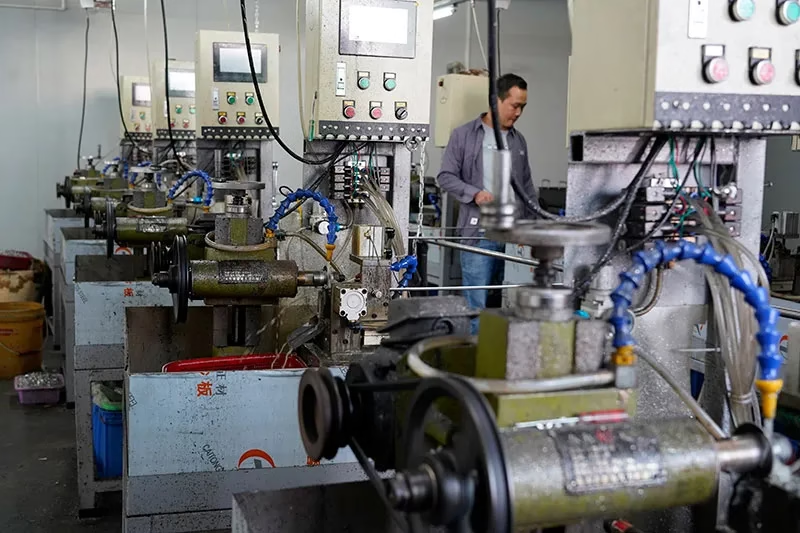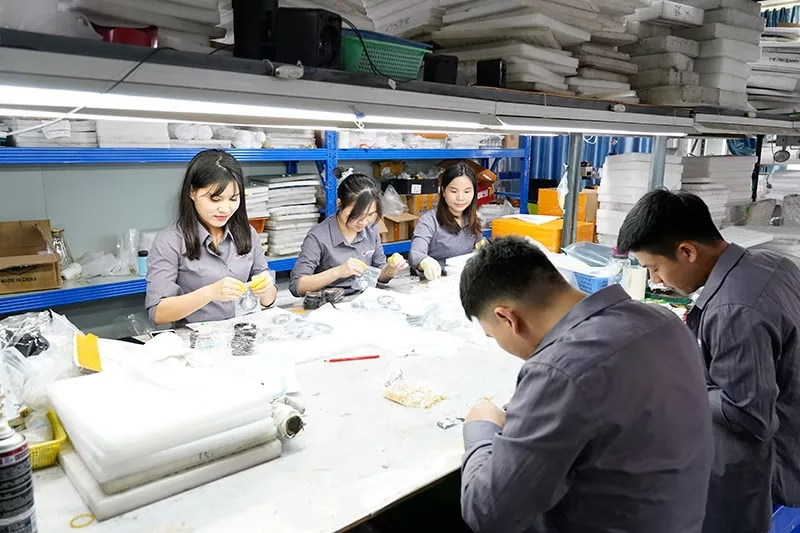
There has been an impressive growth in popularity for stainless-steel jewellery, creating one of the fastest-growing and ultimately the largest parts of the global fashion jewellery market. With the benefits of long-lasting durability, excellent resistance to corrosion, and excellent cost to pay, overall, stainless steel provides a far better value than gold or silver.
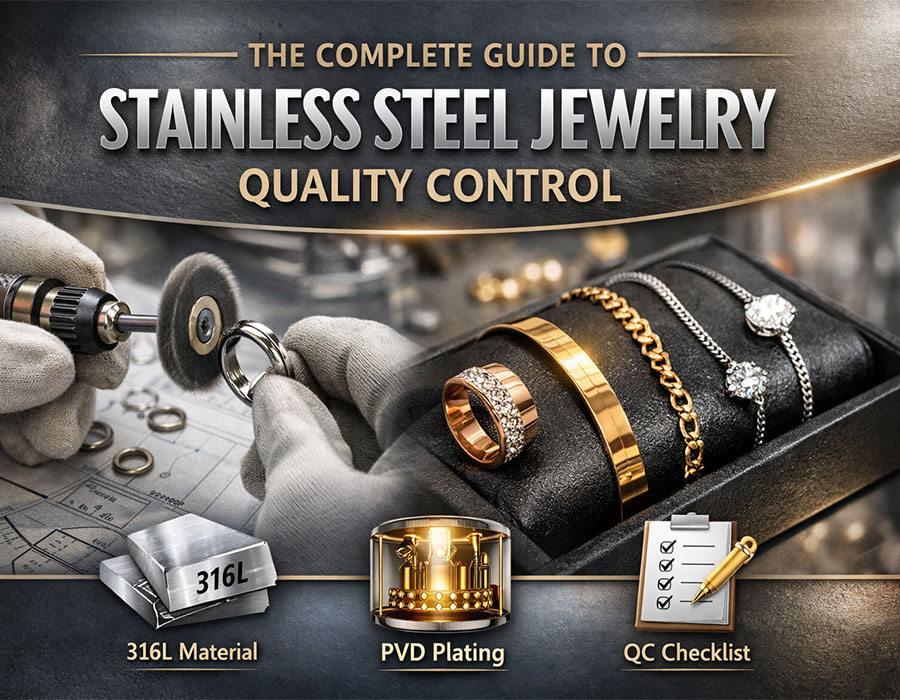
Today, stainless steel is used to make rings, necklaces, bracelets, earrings, pendants, and the like, in addition to other types of fashion jewellery.
However, not every piece of jewellery made with stainless steel will give you the same level of quality. Products made from low-quality stainless steel may have issues, including skin irritation, fading of the finish, weakened welds and joints, and loose or missing stones.
As such, jewellery brands, wholesale customers, and sourcing managers should be knowledgeable about and understand the quality standards governing the manufacturing of stainless steel jewellery.
This guide provides a comprehensive overview of:
- Stainless steel jewelry material standards
- Key manufacturing processes
- A practical QC inspection checklist
- International compliance requirements
- Supplier selection strategies
It can also serve as a quality control manual for sourcing stainless steel jewelry manufacturers.
Why Quality Control Matters in Stainless Steel Jewelry
In global jewelry sourcing, quality control is essential for maintaining product reliability and protecting brand reputation.
Poor quality control can result in several common issues.
Common Quality Problems in Stainless Steel Jewelry
| Issue | Root Cause | Impact |
|---|---|---|
| Skin irritation | High nickel release | Customer complaints |
| Color fading | Low-quality plating | Reduced product lifespan |
| Loose stones | Poor stone setting | Product failure |
| Rust spots | Low-grade stainless steel | Brand damage |
| Broken clasps | Weak structure | Jewelry loss |
Implementing a structured QC system significantly reduces these risks.
Stainless Steel Material Standards for Jewelry
The most important factor affecting the quality of stainless steel jewelry is the material grade.
Among available materials, 316L stainless steel is widely considered the premium choice for jewelry manufacturing.
316L Stainless Steel: The Industry Gold Standard
316L stainless steel is often called surgical-grade stainless steel due to its excellent corrosion resistance and skin safety.
Chemical Composition of 316L Stainless Steel
| Element | Typical Percentage | Function |
|---|---|---|
| Chromium | 16–18% | Corrosion resistance |
| Nickel | 10–14% | Structural stability |
| Molybdenum | 2–3% | Improves corrosion resistance |
| Carbon | Low | Prevents corrosion in welds |
Key Benefits
- Strong resistance to sweat and seawater
- Very low nickel release
- Excellent durability
- Superior polishing performance
These properties make 316L ideal for jewelry intended for long-term wear.
316L vs 304 Stainless Steel in Jewelry
Some manufacturers also use 304 stainless steel due to its lower cost.
The two materials differ in corrosion resistance and long-term durability.
| Feature | 316L Stainless Steel | 304 Stainless Steel |
|---|---|---|
| Corrosion resistance | Excellent | Good |
| Sweat resistance | Very high | Moderate |
| Hypoallergenic | Yes | Usually |
| Cost | Higher | Lower |
For premium jewelry products, 316L stainless steel remains the preferred option.
Stainless Steel Jewelry Manufacturing Process
Understanding the manufacturing process helps buyers evaluate supplier capabilities and quality control systems.
Typical Stainless Steel Jewelry Production Process
| Step | Process | Purpose |
|---|---|---|
| 1 | Material cutting | Prepare stainless steel components |
| 2 | Stamping or casting | Create the basic shape |
| 3 | CNC or polishing | Refine surface and edges |
| 4 | Welding or assembly | Connect components |
| 5 | Stone setting | Install decorative stones |
| 6 | Surface finishing | Polishing or brushing |
| 7 | PVD plating | Apply decorative coating |
| 8 | Final QC inspection | Ensure product quality |
| 9 | Packaging | Prepare for shipment |
Factories with advanced equipment and trained technicians usually produce higher-quality products.
PVD Plating Technology for Stainless Steel Jewelry
PVD (Physical Vapor Deposition) is one of the most important technologies used in stainless steel jewelry finishing.
Unlike traditional electroplating, PVD plating is performed in a vacuum environment where metal particles bond directly to the jewelry surface.
Advantages of PVD Plating
| Feature | Benefit |
|---|---|
| Strong adhesion | Coating bonds tightly to metal |
| High hardness | Improved scratch resistance |
| Color durability | Reduced fading |
| Long lifespan | More durable than traditional plating |
Popular PVD Colors
- 18K gold
- Rose gold
- Gunmetal black
These finishes are commonly used in high-end stainless steel jewelry collections.
Stone Setting Techniques in Stainless Steel Jewelry
Because stainless steel has a hardness comparable to 5–6 on the Mohs scale, setting stones requires specialized techniques.
Common Stone Setting Methods
| Method | Description | Quality Level |
|---|---|---|
| Micro Pavé | Stones set under magnification | High-end |
| Prong Setting | Stones held by metal claws | Premium |
| Bezel Setting | Metal surrounds stone | Durable |
| Glue Setting | Stones attached with adhesive | Budget |
Mechanical setting methods generally provide better durability than adhesive methods.
Stainless Steel Jewelry QC Inspection Checklist
The following QC checklist is commonly used by jewelry manufacturers and sourcing teams.
This checklist can also be converted into an Excel inspection report template.
Appearance Inspection
| Inspection Item | Quality Standard |
|---|---|
| Surface quality | No scratches, pits, bubbles |
| Polishing | Smooth mirror finish |
| Brushed texture | Consistent direction |
| Color consistency | No uneven plating |
| Edge finishing | Smooth edges, no burrs |
Dimensional Accuracy
| Product Type | Tolerance |
|---|---|
| Chain length | ±5 mm |
| Bracelet length | ±5 mm |
| Ring size | ±0.25 size |
Structural Testing
| Test | Requirement |
|---|---|
| Clasp durability | 50 open/close cycles |
| Welding strength | No cracks or dark seams |
| Stone security | No movement under pressure |
| Drop test | 1 meter drop ×3 |
Surface Coating Tests
| Test Method | Procedure | Expected Result |
|---|---|---|
| Alcohol rub test | 75% alcohol for 30 seconds | No color transfer |
| Cross hatch test | Grid cut + 3M tape pull | Coating intact |
| Visual inspection | Compare batch colors | Uniform finish |
Material Authenticity Tests
| Test | Method | Expected Result |
|---|---|---|
| Magnetic test | Strong magnet screening | Very weak magnetism |
| Salt spray test | 24–48 hours | No rust formation |
International Compliance Requirements for Jewelry
Jewelry sold in international markets must meet chemical safety regulations.
Manufacturers usually provide laboratory reports from recognized testing organizations.
Common Testing Organizations
- SGS
- TÜV
- Intertek
- Bureau Veritas
Recommended Testing Frequency
Every 6–12 months.
Global Chemical Compliance Limits
| Substance | Limit | Regulation |
|---|---|---|
| Nickel release | <0.5 μg/cm²/week | EU REACH |
| Lead | <100 ppm | California Prop 65 |
| Cadmium | <100 ppm | EU REACH |
| Phthalates | <0.1% | CPSIA |
Compliance ensures products can legally enter international markets.
How to Choose a Stainless Steel Jewelry Manufacturer
Selecting the right supplier is critical for maintaining consistent quality.
Key Evaluation Criteria
| Factor | What to Check |
|---|---|
| Material quality | Confirm use of 316L stainless steel |
| Manufacturing capability | Equipment and production capacity |
| Surface finishing | PVD plating technology |
| Quality control | Inspection procedures |
| Certifications | Third-party test reports |
Experienced manufacturers typically maintain more stable quality standards.
Professional QC Tips: Hidden Manufacturing Risks
Even when suppliers claim to use high-quality materials, hidden problems may still occur.
Welding Material Risk
Some factories use low-cost welding materials.
Inspection tip:
Check weld seams for discoloration or early rust formation.
Rose Gold Oxidation Risk
Rose gold coatings may oxidize due to copper content.
Inspection tip:
Simulate sweat exposure using saltwater and acetic acid.
Hollow Jewelry Chemical Residue
Hollow products may trap chemical liquids after plating.
Inspection tip:
Shake the jewelry and check holes for white crystalline residue.
FAQ: Stainless Steel Jewelry Quality
Is 316L stainless steel jewelry hypoallergenic?
Yes. 316L stainless steel releases extremely low levels of nickel and is widely considered safe for sensitive skin.
Does stainless steel jewelry tarnish?
High-quality stainless steel jewelry does not easily tarnish. Jewelry made from 316L stainless steel with PVD coating can maintain its appearance for many years.
How long does PVD plating last?
With proper manufacturing and normal wear, PVD plating can last several years without significant fading.
How can you verify stainless steel jewelry quality?
Quality can be verified through:
- Material certification
- QC inspection reports
- Surface testing methods
- Third-party laboratory testing
Conclusion
To produce premium quality stainless steel jewellery, there’s a need to obtain superior raw materials, incorporate cutting-edge manufacturing technology and maintain rigorous quality control practices.
With the incorporation of 316L stainless steel, PVD (physical vapour deposition) plated coatings, and systematic quality control inspections, manufacturers will provide durable, safe, and attractive jewellery.
An established sourcing and inspection strategy is critical for jewellery brands or wholesalers in order to maintain consistency of product quality in the global market.

Emily Tan brings over 12 years of experience in the stainless steel jewelry industry, combining deep product knowledge with keen market insight. Fluent in English and French, she excels at connecting with international clients and driving business growth. As a talented sales manager and company blogger, Emily shares practical industry insights and valuable guidance, earning the admiration of readers and professionals alike.