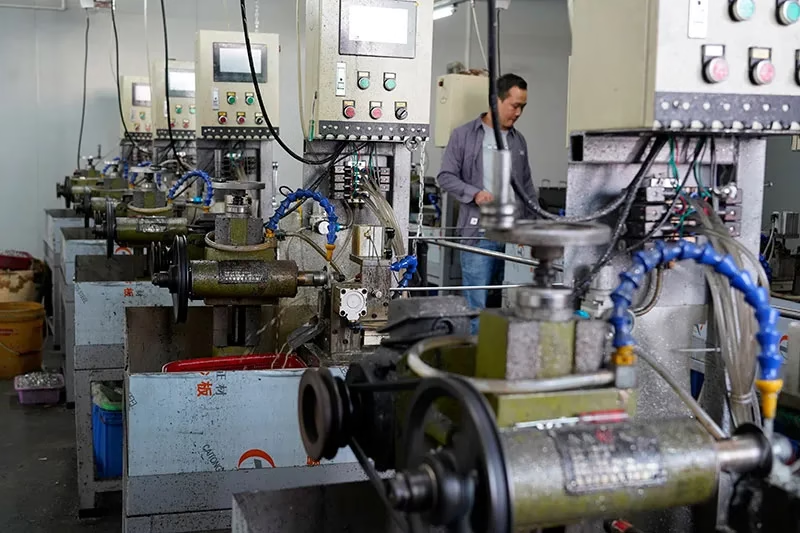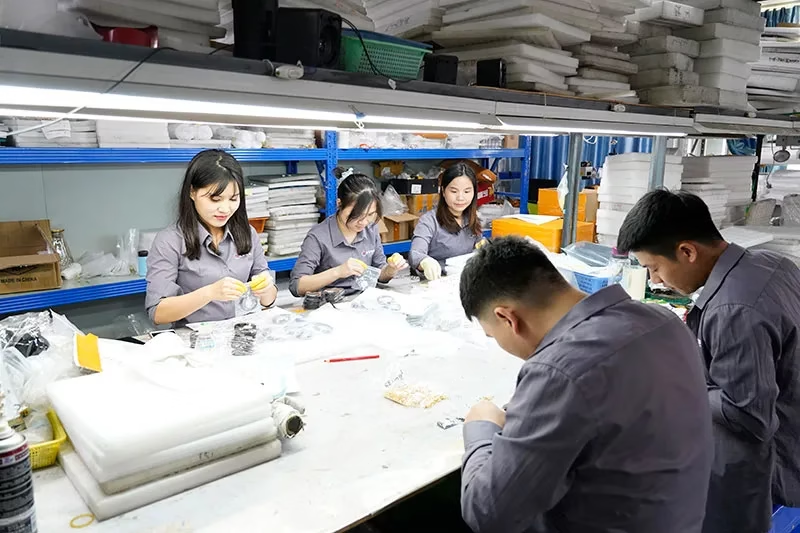
In the premium jewelry market, the “seamless” look is the ultimate benchmark of engineering excellence. While stainless steel is prized for its durability, its inherent hardness makes achieving a fluid, uninterrupted silhouette a significant technical challenge. A truly high-end bangle must appear as a single, continuous loop of metal, where hinges and clasps vanish into the design.
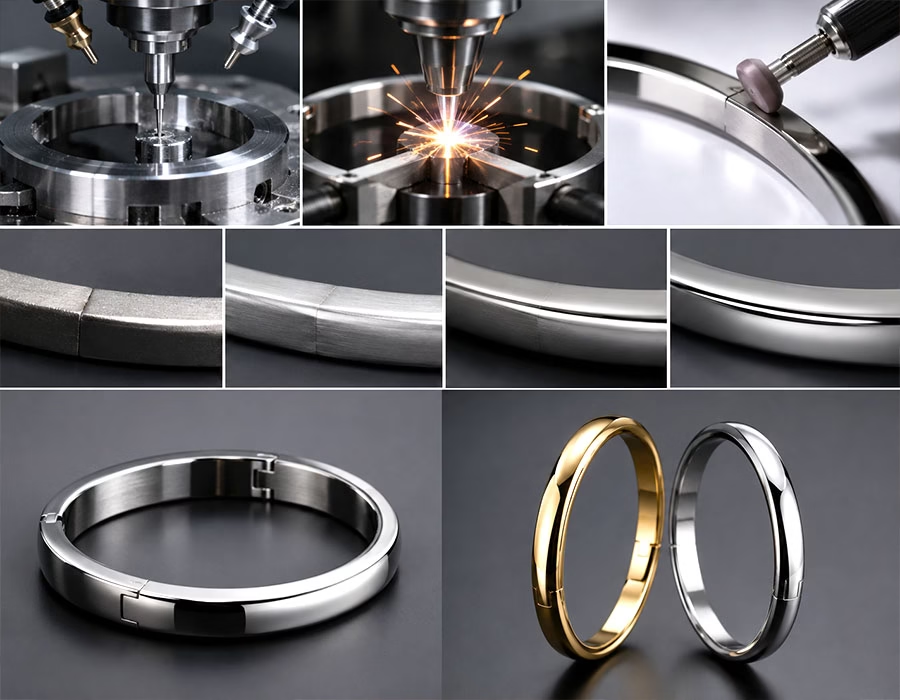
Achieving this level of refinement requires a fusion of precision engineering and artisanal hand-finishing. Because the choice of material impacts every subsequent step, understanding 316L vs 304 stainless steel jewelry is essential for maintaining structural integrity during high-heat laser welding.
The Technical Pillars of Seamless Construction
Creating a seamless appearance involves controlling how the metal reflects light across joints and transitions. This is not merely a surface finish; it is a structural achievement.
1. Precision CNC Milling vs. Casting
Most high-end bangles begin with CNC (Computer Numerical Control) machining from solid steel bars.
- The Advantage: Unlike casting, which can result in microscopic pores or pitting, CNC allows for tolerances as tight as plus or minus 0.01mm.
- The Seamless Result: When the two halves of a bangle meet, the physical gap is so microscopic that it can be mechanically “blended” away. This is a hallmark of high-precision CNC machined jewelry.
2. Advanced Laser Welding Protocols
Where components must be joined, traditional soldering is insufficient. It leaves visible “beads” and changes the metal’s local color. High-energy laser welding creates a deep, narrow weld pool with a minimal Heat Affected Zone (HAZ), ensuring the “split line” remains nearly invisible after the first round of grinding.
3. Geometric Blending and Hand-Finishing
The transition from a weld point to the rest of the bangle body must be handled manually. A machine cannot feel the “wave” in a curve, but a master polisher can. Technicians use graduated abrasives to “feather” the joint area into the surrounding metal, ensuring light travels across the surface without refraction or distortion.
Comparison: Seamless vs. Standard Manufacturing
| Feature | Standard Production | Seamless Engineering |
| Material Base | Cast alloy or 304 steel | Forged 316L Stainless Steel |
| Hinge Design | External barrel hinges | Internal, concealed mechanisms |
| Joint Quality | Visible seams or “steps” | Blended, invisible transitions |
| Surface Uniformity | Machine-only polish | Multi-stage manual mirror finish |
| Plating Integrity | Potential pooling at joints | Uniform PVD molecular bonding |
Common Technical Challenges and Solutions
Designing a seamless piece is only half the battle; mass production introduces variables that can compromise the “one-piece” illusion.
- Weld Distortion: Stainless steel is highly sensitive to heat. Excessive heat causes “spring-back,” ruining the circular geometry. Solution: Utilizing pulsed laser settings to maintain a cool base metal temperature.
- Color Shifts at Seams: Welded areas can react differently to surface treatments. Understanding the electroplating & PVD process for stainless steel is vital to ensure the gold tone remains consistent across the welded joints.
- The “Orange Peel” Effect: Over-polishing a joint can lead to a dimpled texture. Solution: Rigid quality control benchmarks at each grit level.
FAQ: Professional Insights for Buyers
Why can’t a seamless bangle be made from one solid piece of steel?
While a solid ring can be machined, a bangle requires an opening mechanism to fit the wrist. The “seamless” look refers to engineering the hinge and clasp so they are hidden within the profile of the metal when closed.
Does a seamless finish affect the durability of the clasp?
It typically improves it. Seamless designs require higher precision in the locking tongue and groove. A seamless look is usually an indicator of superior structural tension and tighter manufacturing tolerances.
How can I verify a “seamless” claim during quality inspection?
The “Light Reflection Test” is the most effective method. Rotate the bangle slowly under a single, sharp light source. If the reflection “breaks” or jumps at the hinge or clasp area, the blending is incomplete. The light should flow like liquid around the entire circumference.
Final Thoughts
A seamless stainless steel bangle is a product that looks deceptively simple but requires rigorous technical discipline to execute. For brands targeting the luxury-fashion segment, these small transitions define the perceived value of the entire collection. Focusing on the engineering behind the aesthetics ensures your brand stands out for its craftsmanship, not just its designs.

With over 10 years of experience in the stainless steel jewelry industry, Lydia Ling brings deep industry knowledge and hands-on market expertise to her role. As an accomplished Sales Manager, she has a strong understanding of product development, manufacturing processes, and global customer needs. Through the company blog, Lydia shares practical insights and industry know-how to help readers better understand stainless steel jewelry and make informed business decisions.