Let’s face it—jewelry buyers these days mean business. They want pieces they can wear every day, whether they’re at the gym, the beach, or taking a hot shower, and they expect those pieces to hold up without tarnishing, bending, or turning their skin green. This demand for “lifeproof” fashion is what makes 316L stainless steel the best choice for creating custom rings, chains, and earrings.
For jewelry companies and B2B sourcing managers operating with limited resources, material hardness is more than just a technical specification. Hardness of material affects lead times for production processes (tool and equipment wear in factories) as well as (more importantly) return rate from retail customers.
In this article, we will examine the science behind 316L stainless steel and why it’s a great option for producing durable products, including how it performs in manufacturing facilities.
1. The Chemistry: What Makes 316L “Surgical Grade”?
316L is typically sold as surgical steel or as medical-grade stainless steel. This is a very stable, low-carbon, corrosion-resistant austenitic stainless steel alloy, and its “L” designation indicates it is a low-carbon alloy (i.e., less than 0.03 percent carbon).
Because of the very low carbon content (i.e., the amount of carbon in the alloy is close to zero), the risk of the alloy becoming ‘sensitized’ (i.e., the formation of carbides due to high temperatures) when it is subjected to high-temperature applications such as fiber laser cutting or welding is very low. Because of the microscopic properties of the alloy’s stability, it is highly unlikely that the jewelry you create will have any structural weaknesses that are hidden from view due to the development of corrosive materials along weld seams.
2. Hardness Specs: 316L by the Numbers
Here is how genuine, annealed 316L stainless steel stacks up across the industry-standard testing scales:
| Hardness Metric | Certified Testing Range | Real-World Meaning for Jewelry Brands |
| Vickers Hardness (HV) | 120 to 200 HV | The standard window for CNC precision milling. Prevents micro-chipping. |
| Rockwell B (HRB) | 70 to 90 HRB | High dent resistance against accidental impacts and heavy daily drops. |
| Mohs Scale | 5.5 to 6.0 | Outperforms sterling silver; resists scratches from copper keys or coins. |
| Brinell Hardness (HBW) | 140 to 187 HBW | Confirms internal core density and solid structural integrity. |
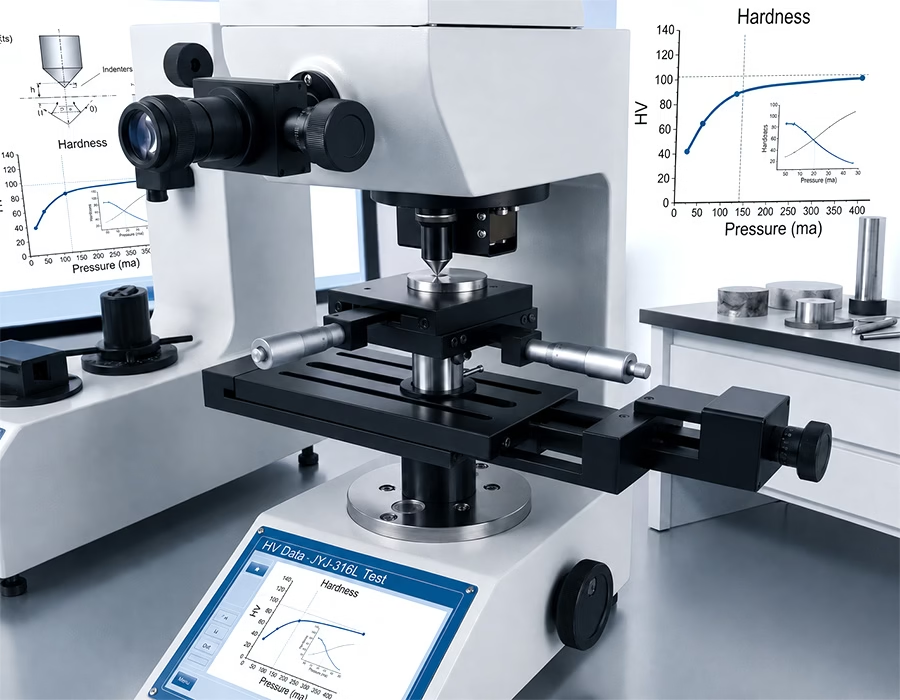
A Quick Warning on Rockwell C (HRC): Because 316L is an austenitic steel, it cannot be hardened by traditional heat quenching. Anyone quoting an “HRC value” for standard raw 316L jewelry is providing inaccurate data that won’t pass an engineering audit.
The Impact of Work Hardening
When we stamp, press, or draw wire for your designs, 316L undergoes work hardening. This mechanical pressure refines the grain structure, pushing surface hardness up toward 100 to 200 HBW (and up to 260 HBW under extreme rolling). This natural process boosts scratch resistance, but factories must balance it carefully—over-hardening makes the metal brittle and difficult to engrave.
3. The Sourcing Sweet Spot: 316L vs. 304 Steel
When cutting costs, budget factories often swap out 316L for 304-grade stainless steel. While 304 is tough and holds a slightly higher initial surface hardness, it misses the crucial elements required for premium jewelry lines.
For a deep dive into this material showdown, check out our 316L vs 304 Stainless Steel Jewelry: Full Guide.
Why 316L’s Ductility Wins
Though 304 is technically harder out of the box, 316L offers superior material ductility (malleability) due to its higher nickel content.
When executing crisp geometric edges, clean custom logos, or fine laser engravings, 316L flows smoothly under the tool bit instead of snapping or leaving jagged edges. Plus, 304 completely lacks Molybdenum, meaning it will eventually pit and tarnish when exposed to heavy sweat or coastal salt air.
4. Why Structural Hardness Protects Your Collections
Zero Warping, Total Retention
Softer jewelry bases like brass or sterling silver easily bend or warp under normal wear. With a high tensile yield strength of around 570 MPa, 316L ensures that minimalist geometric bands, open cuff bracelets, and delicate earring posts remain rigid and retain their intended shapes forever.
Flawless Polish & Secure Stone Settings
Harder metals stay smooth longer. On highly reflective, mirror-finished pieces, this surface density prevents light from scattering off microscopic scuffs, preserving a premium, platinum-like shine.
Even better, a rigid 316L base means the micro-prongs holding Cubic Zirconia (CZ) or crystals won’t loosen or pull open, drastically cutting down your factory defect and return rates.
5. How Base Hardness Unlocks Premium PVD Gold Plating
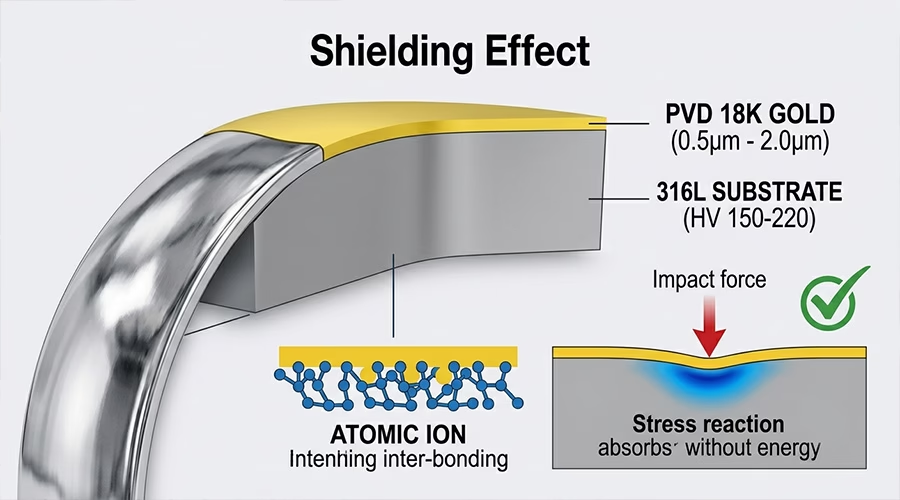
If your brand sells luxury gold tones, pairing 316L stainless steel with PVD (Physical Vapor Deposition) coating is non-negotiable. Traditional electroplating on soft brass acts like a fragile topcoat that flakes off within months. PVD on hard 316L creates a molecular, atomic-level bond.
The “Shielding Effect”
Real gold is soft, so a PVD gold film (usually 0.5 to 2.0 microns thick) needs a rock-solid foundation:
- The Soft Base Trap: Plating over soft brass (50-150 HV) forms a hollow shell. A minor ding crushes the soft brass underneath, causing the rigid gold film to crack, buckle, and peel.
- The Jinyuan Solution: The high hardness of 316L absorbs the impact without budging. Because the base layer never deforms, the gold film stays locked in place, extending the life of your gold finish to 3 to 5 years of daily wear.
To master this look for your brand, read our factory guide on How to Achieve a True 18K Gold Color on Stainless Steel.
6. Sourcing Challenges: What Your Team Needs to Know
While 316L delivers incredible retail performance, its extreme hardness requires a specialized production workflow:
- Extended Lead Times: Machining a tough metal like 316L takes time. Expect your production windows to run 1 to 3 weeks longer than brass or zinc alloys. Sourcing teams should factor this into their launch calendars.
- The PVD Shadow Effect: PVD is a line-of-sight vacuum process. Because 316L has an intense melting point (1375 to 1400 degrees Celsius), complex, hollow, or deeply layered filigree designs can be tricky to plate evenly.
- The Fix: We solve this by utilizing multi-axis rotating racks inside the vacuum chamber or engineering the jewelry as modular pieces that are polished, plated, and cleanly assembled via fiber laser welding.
7. B2B Quality Control: Your 5-Step Check
Before signing off on mass production shipments, protect your brand by enforcing these five quality assurance steps:
- Demand Mill Test Reports (MTR): Ensure the raw steel batch tests at 2.0% to 3.0% Molybdenum and strictly under 0.03% Carbon.
- Run an Artificial Sweat Test: Submerge random samples in a high-salt, acidic sweat solution for 48 to 72 hours. Low-grade alloys will pit; genuine 316L remains spotless.
- Check Physical Density: True 316L must hit a density of 7.98 grams per cubic centimeter. If a shipment feels surprisingly light or hollow, you’re looking at a cheap zinc-alloy substitute.
- Inspect the Edges: Run your fingers over the clasps, hinges, and inner bands. High-grade 316L that has undergone proper centrifugal polishing will feel flawlessly smooth, with no sharp burs.
- Verify Compliance Documentation: Ensure ear wires and piercing components are certified compliant with ISO 10993 (Biocompatibility) and EU REACH nickel release limits. See how we maintain these benchmarks in The Complete Guide to Stainless Steel Jewelry Quality Control.
Frequently Asked Questions (FAQ)
Is 316L stainless steel harder than sterling silver or gold?
Yes. 316L steel ranges from 120 to 200 HV, making it significantly harder than sterling silver (60 to 100 HV) and standard 14K gold (100 to 150 HV). It offers far better resistance to dents and scratches.
Will 316L jewelry ever scratch?
While highly scratch-resistant, it isn’t diamond-proof. Contact with harder materials like quartz, sapphires, or hardened steel tools can still leave faint surface marks.
Is 316L steel completely hypoallergenic?
Yes, it is globally recognized as medical-grade surgical steel. The nickel within its formula is tightly locked inside an austenitic molecular matrix, preventing it from leaching onto the skin and making it safe for highly sensitive ears and piercings.
Can you resize a 316L stainless steel ring?
No. Because of its massive melting point and hardness, traditional jeweler torches cannot resize a 316L ring. Any adjustments require high-powered industrial laser-welding setups. Always confirm your sizing matrices before opening the mass mold.
Build Your Next Collection on a Solid Foundation
For fashion brands looking to scale their waterproof, non-tarnish jewelry lines, 316L stainless steel is the ultimate industrial design solution. By matching rugged hardness with excellent workability, it allows you to launch bold, structural collections that look better, last longer, and cut your defect rates to near zero.
About Jinyuan Jewelry
Over the last two decades, Jinyuan Jewelry has gained extensive experience in manufacturing and established itself as an OEM/ODM B2B stainless steel jewelry manufacturer. Jinyuan Jewelry is located in Dongguan, China, and specializes in custom precision fabrication, sophisticated CNC machining, and superior vacuum PVD plating.
We assist brands worldwide in developing fully compliant, high-performance jewelry lines that attract considerable market attention.

Emily Tan brings over 12 years of experience in the stainless steel jewelry industry, combining deep product knowledge with keen market insight. Fluent in English and French, she excels at connecting with international clients and driving business growth. As a talented sales manager and company blogger, Emily shares practical industry insights and valuable guidance, earning the admiration of readers and professionals alike.